Advancing the EU Cities Mission: Irish cities, European networks and the future of urban climate finance meet in Cork
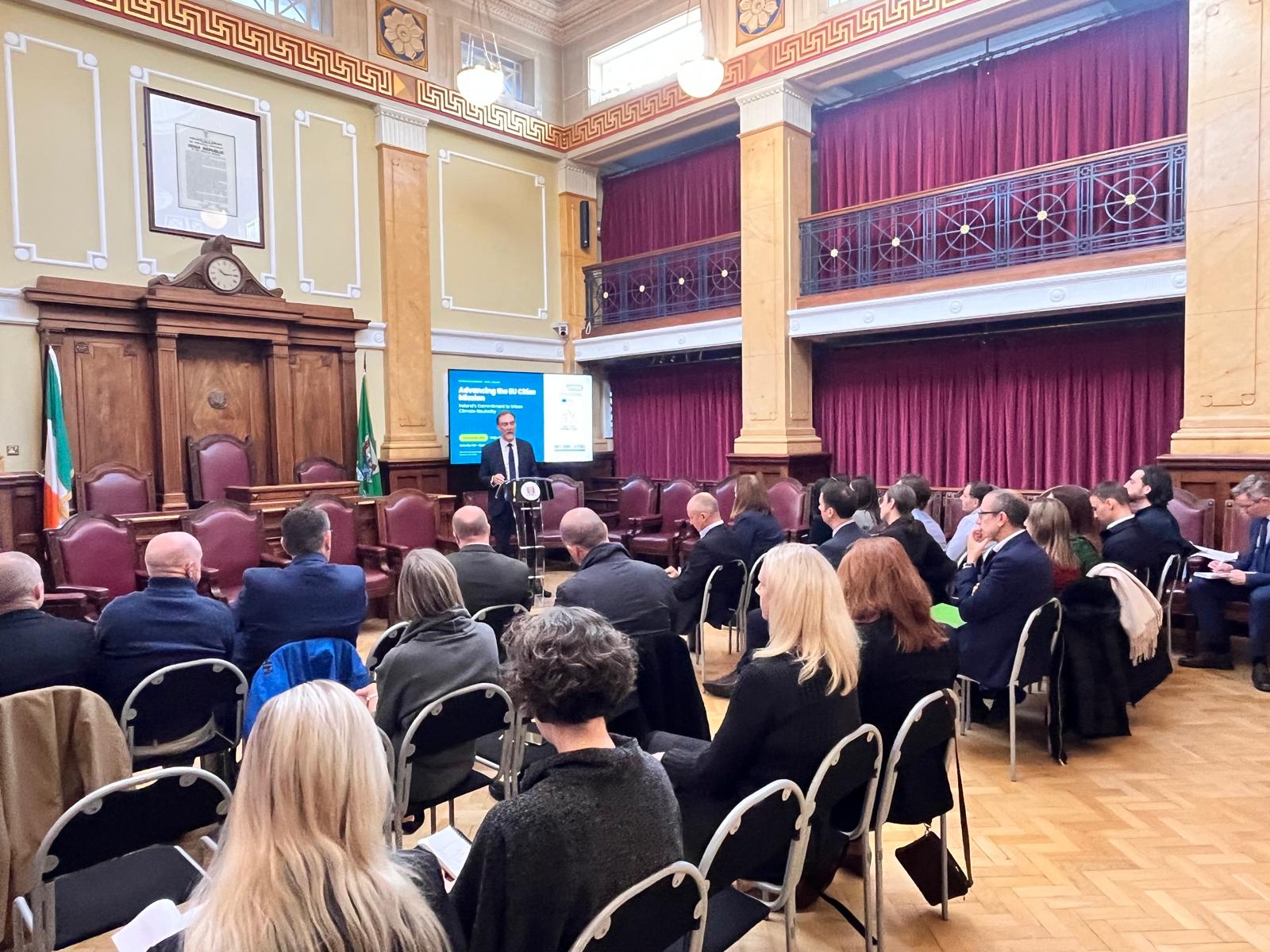
Cork, 13 November 2026. Cork City Hall’s Council Chamber hosted Advancing the EU Cities Mission: Ireland’s Commitment to Urban Climate Neutrality, a CapaCITIES Network event recognised as an Associated Event of the Irish Presidency of the Council of the European Union. Over a full day, Ireland’s five Mission and Mission-minded cities, national partners, European networks of national Mission platforms and NetZeroCities came together to take stock of progress, share what is working on the ground and look ahead to how the urban transition will be financed after 2027.
Irish cities on the road to climate neutrality
We were welcomed by Lucy Pyne from the Department of Climate, Energy and Environment, on behalf of the National Mirror Group. This is the national space for the EU Cities Mission, which the Department facilitates to bring cities and relevant stakeholders together. From 2026, the Department has put in place a funding mechanism that allows Local Authorities to work on specific climate projects. The Accelerator Mission Fund offers cities easy access to funding, lets them set their own priorities, and keeps management practical and straightforward. The fund allocates €2 million in 2026 and will expand to €5 million in 2027, including the Mission Minded cities as well.
The morning belonged to the cities. Representatives of Cork, Dublin, Galway, Limerick and Waterford presented their journeys towards climate neutrality, each from a different starting point.
Cork, awarded the EU Mission Label in February 2025 for its Climate City Contract, opened the programme. David Joyce, Director of Services for Emergency Management and Climate Action at Cork City Council, set out the city’s baseline of 977.9 ktCO₂e (2023) and the gap between current national projections and the Mission’s 2030 target, calling for an urgent discussion on the additional actions cities need. He put the investment needed at €14.5 billion, shared between citizens (€6.45 billion), government (€4.47 billion) and the private sector (€3.57 billion), and stressed that the co-benefits, from cleaner air and better health to jobs and community wellbeing, are part of the case for acting. Looking ahead, he highlighted the National Mirror Group as a space for cities to build partnerships with government departments and state agencies, called for the Mission City Accelerator Fund to be scaled up and made multi-annual, and underlined the need for private finance alongside public funding for projects with a social and climate return but no cash return. He also called for climate adaptation, guided by the principle of resilience by design, to be better integrated into national and local planning.
Dublin, represented by Alan Sherry, Senior Executive Officer at Dublin City Council, presented the challenges of measuring impact, decarbonising the building stock, electrifying transport and acting at scale, alongside the city’s participation in initiatives such as EUREKA, EURADAPT, EU Cities Gateway and the NetZeroCities Pilot Project Build Capa-Cities, implemented together with Cork. Examples included the transformation of Capel Street, the Active travel counts incentive accounting for strong growth in walking and cycling between December 2024 and December 2025, the community food initiative Eat the Streets, the upcoming transformations by the IMEND integrated mobility, ecological and nature-based drainage project and the Grow College Green, which will bring a traffic-free public realm, 75 new trees and an increase in greening from 0% to 30% to the heart of the city.
Galway, represented by Sharon Connolly, Head of Climate and Sustainability for the Galway City Council) integrating climate mitigation measures such as energy retrofitting of existing council buildings, replacement of inefficient heating system with low-carbon alternatives (e.g., heat pumps), integration of renewable technologies (e.g., PV on rooftops), among others; with climate Adaptation initiatives including Nature Based Solutions to address their high exposure to flood risks. Additionally, they have a community climate action fund, in 2026 allocates €505,5K for 17 community projects on energy, transport, biodiversity, circular economy, among others.
Limerick, represented by Kieran Reeves, Climate Action Coordinator at Limerick City and County Council, described the shift from an organisational focus to a whole-of-society approach. With the council itself responsible for just 0.2% of total emissions, Limerick is building an ecosystem centred on citizen-led transition and innovation, including its Citizen Innovation Lab. They are working on district heating feasibility study and a solar feasibility study at the Gort na Droma landfill. As Limerick put it, the challenge is not only how to pay for the transition, but how to motivate society to make it.
Waterford, represented by Gráinne Kennedy, Climate Action Coordinator at Waterford City Council also shared their cities’ perspectives such as their approach to help business to be ambassadors to the climate change, working on the narratives. Currently the city is involved in the NetZeroCities Twinning Learning Programme, paired with Bristol. They are working on hot to pair organisations and engage local communities in the transition.
A European alliance of national Mission networks
After the break, the CapaCITIES Network presented its work to build a transformative European alliance to accelerate the transition. Speakers from national Mission platforms across Europe took part: Maria Tengvard (Viable Cities, Sweden), Moises Alvaro (citiES2030, Spain), Maria Neneciu (M100, Romania), Taina Tukiainen (Finnish Cities Mission Network, Finland) and Nicolas Francart (Concito, Denmark).
The discussion explored the different models of multi-level governance through which national platforms connect cities with regional and national authorities, as well as the wide range of formats and projects they have developed. These range from multi-city projects and capacity-building programmes to tailored technical support, spaces for dialogue and networking, and initiatives that build trust between actors and grow a national ecosystem around the Mission. Together, these experiences showed how national networks can support cities, connect them with national governments and help turn Mission ambitions into delivery.
Support for Irish cities: the NetZeroCities Community of Practice
Nikita Shetty of BABLE Smart Cities presented their work on supporting the development of the Irish Community of Practice between cities, a project supported by the NetZeroCities’ City Expert Support Facility. Their work integrates Department of Climate, Energy and the Environment (DCEE) and the five cities over 18 months, into thematic working sessions where key actors from the Irish ecosystem are invited.
Three working sessions have been delivered so far, on EU and grant funding, retrofit and the built environment, and financing retrofit. They are already producing results: the funding work has been opened up to every local authority, reaching around 50 participants from more than 20 local authorities, and the retrofit session led to a dedicated SEAI session and new collaboration on EU proposals. Representatives of Cork, Dublin and Limerick took part in a short rapid-fire round on what has been most useful and what still needs to be solved.
A concrete outcome is a joint LIFE Strategic Integrated Project application for the five cities, led by DCEE and submitted at Stage 1 in September 2026: an €18 million project, including an €11 million LIFE grant, aiming to leverage more than €100 million over 96 months from 2027, with SEAI and the National Transport Authority among the national partners.
The session also named five barriers the cities still face: tightly controlled council borrowing that leaves a co-financing gap for ready projects; limited capacity in contractors, staff and administration; the need for scale and a shared national framework to attract competitive finance; the need for blended finance for deep decarbonisation; and the lack of a working model for the private and commercial building stock. Over the remaining eight months of the support, the aim is to tackle these barriers and use Mission-city status to pilot what national programmes do not yet allow.
Financing the urban transition after 2027
The day closed with a panel organised by ICLEI Europe and NetZeroCities, Financing the Urban Transition after 2027: How Can the Next EU Budget Enable Mission Cities to Deliver their Planned Investments?, moderated by Jennifer McIntosh (ICLEI Europe, NetZeroCities).
As Mission Cities move from planning to implementation, the opening presentation set out what the next Multiannual Financial Framework (2028–2034) could mean for them. The Commission has proposed a budget of almost €2 trillion (€1,984.9 billion in current prices), including an €865.1 billion Partnership Fund, of which €782.9 billion would go to 27 National and Regional Partnership Plans (NRPPs) that would bring together cohesion, agriculture, fisheries and home affairs funds in one plan per Member State, with payments linked to milestones and targets. A further €409.3 billion is proposed for the European Competitiveness Fund and Horizon Europe.
For cities, this means more decisions taken through national plans, competition across more policy priorities, new potential routes for investment and innovation, and technical assistance that is not yet clearly defined. The Council’s negotiating box of 10 October reduces the overall budget to €1,825.5 billion and contains no dedicated cohesion funding or urban earmarking, while the European Parliament opposes merging policies into a single plan and supports allocating 11% of the ERDF to integrated territorial and urban development. With a political agreement targeted for the end of 2026 and Member States already drafting their plans, the message was clear: cities need to engage now to bring the investments in their Climate City Contracts into national planning.
The panel brought together Ioannis Sagias (DG Research and Innovation, European Commission), Peter Medway (City of Cork) and Claire Roumet (Energy Cities and NetZeroCities). They discussed what is foreseen for Mission-related investment in the next MFF, how to make sure funding reaches the local level and supports Climate City Contracts beyond 2030, and what cities should expect from the final phase of negotiations, including the role of NetZeroCities support.
The exchange with the audience turned to safeguards for predictable city access to EU funds, preparing CCC investment portfolios, the technical assistance cities need most, and how to combine EU, national, public-bank and private finance without overloading cities with administration.
Looking ahead
The day showed both how much Irish cities have already achieved and how much depends on the decisions now being taken under the Irish EU Council Presidency, in Dublin and Brussels. From local projects and national support structures to European networks and the next EU budget, the common thread was clear: cities are ready to deliver, and they need the partnerships, capacity and long-term finance to do it. The event was a first step towards a broader conversation on financing climate-neutral urban transitions in Ireland and across Europe, one that the CapaCITIES Network will continue to support.
The event was organised by the CapaCITIES Network with NetZeroCities, as an Associated Event of the Irish Presidency of the Council of the EU (Éire 2026).