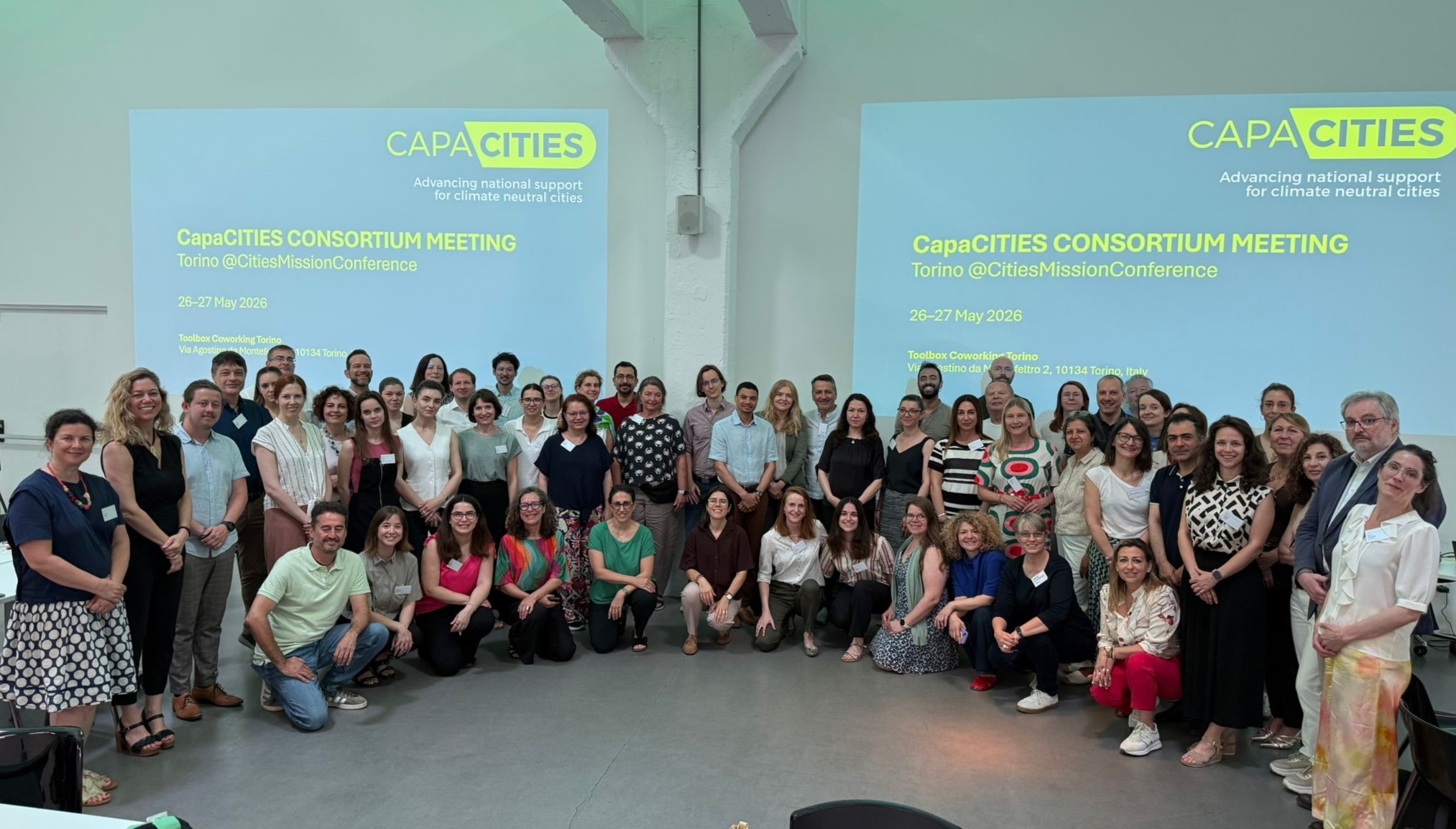
CapaCITIES Consortium Meeting in Torino Strengthens Collaboration and Momentum for Climate-Neutral Cities
On 26–27 May 2026, partners of the CapaCITIES 2.0 project gathered in Torino for a two-day consortium meeting held in the context of the Cities Mission Conference 2026, organised by the European Commission, NetZeroCities, and the City of Torino from 27–29 May 2026.
Hosted at Toolbox Coworking Torino, the meeting brought together consortium partners, national platform representatives, and European stakeholders to reflect on progress, exchange experiences, and align next steps for supporting climate-neutral and smart cities across Europe.
Opening the Floor
The meeting opened with welcome remarks from Elena Simion (UEFISCDI, Romania), followed by contributions from Laura Hetel of the EU Mission on Climate-Neutral and Smart Cities at the European Commission and Yannick Bousse from CINEA. Their interventions connected the consortium’s ongoing work with the wider ambitions and momentum of the EU Cities Mission.
The opening session framed the two-day programme as an opportunity not only to review progress, but also to strengthen collaboration and identify concrete pathways for implementation and scaling.
Taking Stock Across Work Packages
A central component of Day 1 was the Work Package Overview Panel, where WP leaders presented strategic objectives, current activities, key challenges, and areas where additional collaboration and support are needed across the consortium. Discussions highlighted the growing maturity of National Mission Platforms and the increasing importance of coordinated governance structures, peer learning, and implementation support.
WP1 showcased the development of the Learning Portfolio and transnational alliance activities focused on strengthening collaboration, capacity building, and exchange between countries, cities, and institutions. Particular attention was given to financing and funding, regulation and legislation, and monitoring and reporting systems as key areas for future learning activities.
WP2 sessions focused on the implementation of National Mission Platform Self-Assessments and Country Action Plans. Discussions surfaced several shared challenges across countries, including fragmented governance structures, unstable political cycles, insufficient long-term funding, limited monitoring and MRV systems, and stakeholder fatigue linked to overlapping initiatives. At the same time, partners identified common priorities around strengthening national ecosystems, improving access to finance, supporting implementation, and expanding collaboration across governance levels.
A recurring theme throughout the discussions was the need to move “from buzzwords to concrete programmes,” with participants emphasising practical implementation pathways, stronger coordination mechanisms, and clearer links between local, national, and European action.
Synergies, Collaboration and Shared Learning
The afternoon networking session on “Synergies with Other Mission Initiatives” created space for direct exchanges between consortium partners and representatives from initiatives including the New European Bauhaus (NEB), Adaptation Hubs, NetZeroCities, Driving Urban Transitions (DUT), and Mission Innovation.
Interactive discussions and rotating table sessions highlighted strong interest in:
- strengthening connections between mitigation and adaptation agendas;
- creating more opportunities for transnational networking and collaboration;
- aligning governance structures and national support systems;
- developing Smart Policy Labs and innovation spaces;
- supporting implementation through stronger coordination and knowledge exchange.
Participants also stressed the importance of reducing fragmentation between initiatives and creating clearer pathways for cities and national platforms to access support, funding, expertise, and partnerships.
Capacity Building and National Consultation
Day 2 opened with a National Consultation Panel featuring a “bird’s eye view” of the Mission from Philippe Froissard, Deputy Mission Manager at the European Commission. This was followed by breakout working groups dedicated to governance and platform structures, implementation and capacity building, networking, deep collaboration, and common narratives.
The discussions reinforced the importance of multi-level governance, long-term political support, and stronger collaboration between cities, national authorities, and stakeholders. Participants also highlighted the role of communication and shared narratives in making climate action more tangible, inclusive, and implementation-oriented.
A transversal theme emerging across multiple sessions was the importance of communicating climate action through the lens of co-benefits. Participants stressed that climate neutrality strategies should not only be framed around emissions reduction targets, but also around the broader social, economic, and quality-of-life improvements they can generate for citizens and communities.
Co-benefits were identified as an essential element for:
- engaging civil society and strengthening public ownership of climate transitions;
- communicating more effectively with local communities and inhabitants;
- supporting stakeholder mobilisation and cross-sector collaboration;
- improving the attractiveness of investment cases and financing opportunities;
- connecting climate action with health, wellbeing, resilience, affordability, and social innovation outcomes.
This perspective was particularly relevant in discussions around stakeholder engagement, implementation support, monitoring systems, and communication strategies, where participants underlined the need to make climate transitions more concrete, relatable, and beneficial for everyday life.
The afternoon Capacity Building Sessions focused on two major themes:
- monitoring climate action through data governance, impact measurement, and digital tools;
- national support mechanisms for funding and project implementation.
Country examples from Denmark, Bulgaria, France, Austria, Croatia, Poland, Romania, Spain, and Sweden illustrated different approaches to monitoring systems, financing mechanisms, and stakeholder engagement.
Stakeholder mobilisation also featured prominently, with the presentation of the Stakeholder Mobilisation Strategy and Engagement Plans aimed at broadening outreach and strengthening collaboration with cities, regions, and national actors in the coming months.
Looking Ahead
The meeting concluded with a wrap-up plenary focused on next steps and upcoming milestones for the consortium. Partners left Torino aligned around shared priorities and energised by the broader context of the Cities Mission Conference 2026.
Several key takeaways emerged from the two days:
- the need to strengthen governance and coordination across levels;
- the importance of stable funding and implementation support;
- the growing relevance of monitoring, data governance, and evidence-based policymaking;
- the value of peer learning, transnational collaboration, and cross-initiative synergies;
- the necessity of translating climate ambition into practical and scalable action;
- the importance of communicating co-benefits to strengthen engagement with citizens, stakeholders, investors, and public authorities.
The proximity to the Cities Mission Conference served as a strong reminder of both the urgency and the opportunity surrounding Europe’s transition towards climate-neutral cities.