Strengthening MRV frameworks for climate neutral cities: Progress in CapaCITIES 2.0
Challenges related to monitoring, reporting, data collection, governance, impact evaluation and learning – collectively referred to in CapaCITIES as Monitoring, Reporting and Verification (MRV) – continue to be identified by country partners as a major barrier to urban climate transition. While there is growing recognition of the importance of robust data collection and monitoring, many cities and supporting institutions still struggle with fragmented approaches, limited capacities and a lack of coordinated frameworks.
Country partners have repeatedly emphasised the need to better support cities in collecting data and tracking progress. Existing monitoring systems are often disaggregated and disconnected across local, regional and national levels, with insufficient integration of data from other relevant stakeholders such as industry. This fragmentation creates significant challenges for assessing progress, demonstrating impact and informing decision-making. Building on lessons from the first phase of CapaCITIES, MRV was identified as a priority area for deeper exploration in CapaCITIES 2.0. The topic featured prominently in partner self-assessments and country action plans, where it was once again highlighted as one of the most pressing challenges.
To address this need, CapaCITIES established an MRV Task Force bringing together interested country partners. To date, four meetings have been held with representatives from Austria, Bulgaria, Croatia, Denmark, Finland, France, Germany, Portugal, Spain and Sweden. The group is currently collecting and analysing good MRV practices from across participating countries to identify approaches that can support more effective and coordinated monitoring systems. Country partners have also been actively contributing to external discussions on MRV. Recent exchanges included presentations during the Daring Cities conference (Sept 2025) and the Finland–Sweden Smart Cities conference (April 2026), where partners from Denmark, Finland, Germany, Portugal and Sweden shared experiences and insights from their ongoing work.
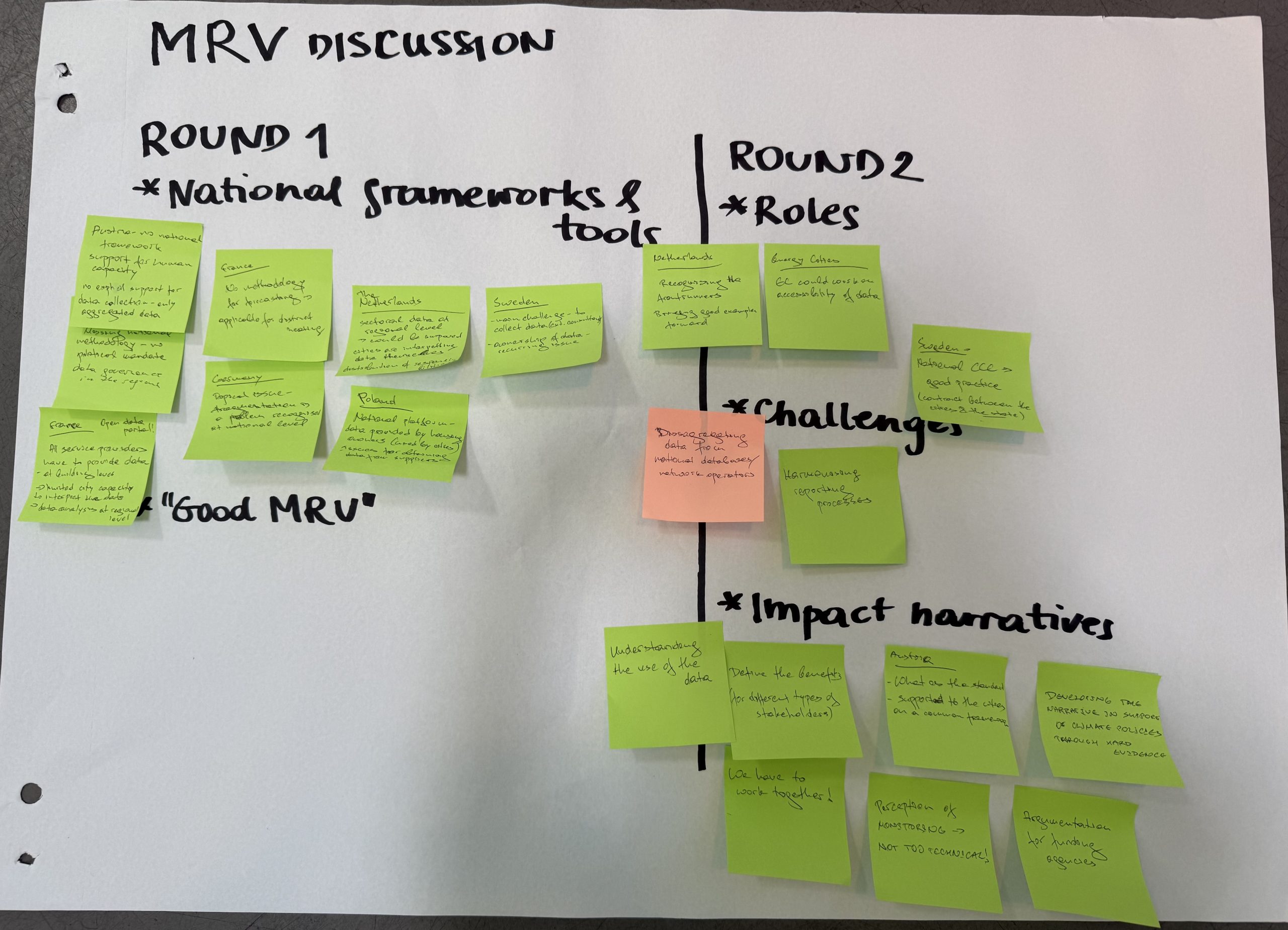
The discussion continued during an interactive session in Torino (May 2026) hosted by partners from Bulgaria, Denmark and France, which highlighted several key messages. First, monitoring must be designed as a meaningful activity that delivers clear value to municipalities. Simplifying processes and creating a single entry point for data that feeds into a coordinated framework would significantly reduce administrative burdens. This is particularly important given that monitoring remains resource-intensive and many cities lack sufficient staff capacity.
Second, participants stressed the importance of coordinated monitoring frameworks. Multiple reporting platforms and incompatible tools increase the workload for cities, which are often required to provide similar information through different channels. Better alignment across systems would improve efficiency and data quality.
Participants also emphasised the potential to link monitoring more closely to funding decisions, enabling clearer assessments of what works, where impacts are being achieved and how investments can be directed most effectively. Targeted capacity building and additional human resources were identified as essential for strengthening local MRV practices.
Finally, the discussion underscored that monitoring is not only about collecting numbers and datasets. MRV can also help build compelling narratives about climate transitions by capturing co-benefits such as improvements in health and wellbeing, economic opportunities and resilience. These broader stories are often crucial for building support and demonstrating the value of climate action.