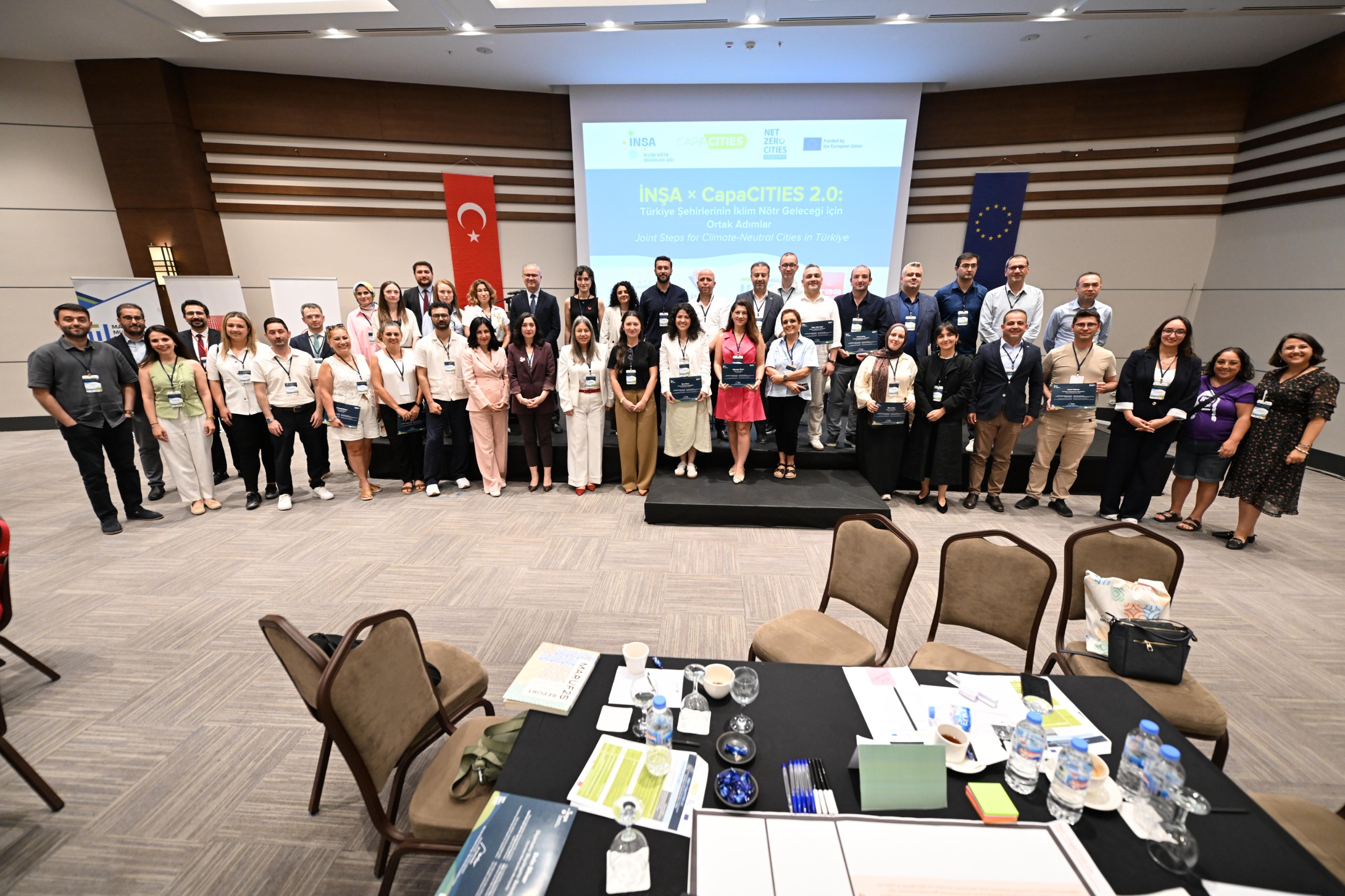
İNŞA × CapaCITIES 2.0 brings cities and national stakeholders together to advance Türkiye’s climate-neutral transition
The event “İNŞA × CapaCITIES 2.0: Joint Steps towards a Climate-Neutral Future for Turkish Cities”, held on 16–17 July 2026 in Ankara, brought together public institutions, local governments, European city initiatives, international organisations and city representatives around a shared objective: accelerating the transition towards climate-neutral cities in Türkiye.
The two-day programme aimed to strengthen the transformation capacity of Turkish cities in line with the EU Mission on Climate-Neutral and Smart Cities, connect national experience with European practices, and contribute to a common vision for the future development of a National Mission Centre in Türkiye. The event was jointly organised within the framework of the Türkiye Climate-Neutral Cities Network – İNŞA Learning Programme, implemented by the Marmara Municipalities Union through the NetZeroCities City Expert Support Facility, and the EU-funded CapaCITIES 2.0 project, implemented in Türkiye by the Union of Municipalities of Türkiye and TÜBİTAK.
A shared vision for climate-neutral cities
The opening session highlighted the collective commitment of local authorities, national institutions, European partners and international initiatives to supporting urban climate transformation.
Opening remarks were delivered by Dr M. Cemil Arslan, Secretary General of the Marmara Municipalities Union; Feridun Ulutaş, Deputy Secretary General of the Union of Municipalities of Türkiye; Joanna Kiernicka-Allavena, Deputy Director of NetZeroCities and the Climate KIC Cities Cluster; and Bülent Özcan, Director General for Financial Cooperation and Project Implementation at the Directorate for EU Affairs of Türkiye’s Ministry of Foreign Affairs.
Speakers emphasised that local governments are among the most important actors in the climate-neutral transition and that long-term cooperation, peer learning and strong partnerships between public institutions, municipalities, businesses and local stakeholders are essential for translating climate ambitions into action. The opening session was followed by a presentation from Çağrı Yıldırım, Director of EU Framework Programmes at TÜBİTAK and National Coordinator of Horizon Europe, who introduced the main principles of the EU Mission on Climate-Neutral and Smart Cities and discussed its relevance for Türkiye. He highlighted Horizon Europe as a strategic instrument for supporting urban transformation and underlined the importance of coordinated action between institutions working towards common climate objectives.
Connecting European experience with local knowledge
Technical sessions introduced the support mechanisms developed through NetZeroCities and the Climate City Contract approach. Discussions showed that the journey towards climate neutrality must go beyond emissions reduction and address governance, stakeholder engagement, finance and investment planning in an integrated manner. The presentation of the CapaCITIES 2.0 project offered an overview of capacity-building activities taking place across Europe, the role of national mission platforms and approaches designed to strengthen knowledge exchange between cities and national stakeholders. The session provided a framework for exploring how European experiences and support models can be adapted to Türkiye’s institutional and urban context.
During the session “Building a Climate-Neutral Future Together”, the Marmara Municipalities Union presented the activities developed through the İNŞA Network and discussed how solidarity, peer exchange and co-creation can support cities throughout their transition. Participants were also introduced to the Climate-Neutral, Smart and Resilient Cities initiative, which supports the institutional transformation and capacity development of local governments in the fields of climate action and urban resilience.
National Mission Platforms share lessons from across Europe
The first day concluded with a panel on National Cities Mission Platforms, moderated by Olga Krajewska from ICLEI Europe.
Representatives of national platforms from Austria, Sweden, Denmark and Romania shared their experiences of building governance models, coordination mechanisms, capacity-building programmes and multi-stakeholder partnerships to support climate-neutral cities.
Although the countries have developed different institutional models, the discussion revealed several common success factors: sustained cooperation, effective national coordination, knowledge sharing and long-term commitment. The exchange also demonstrated the value of the CapaCITIES community in connecting national initiatives and enabling countries to learn from one another while developing approaches adapted to their own administrative and policy contexts.
From local implementation to climate finance
The second day focused on practical experience from Turkish cities. Representatives of the Metropolitan Municipalities of Istanbul, İzmir, Gaziantep and Eskişehir presented their work on greenhouse gas inventories, Sustainable Energy and Climate Action Plans, data-driven planning, energy efficiency, renewable energy and sustainable mobility. The discussions illustrated how cities can pursue similar climate objectives through different locally adapted pathways and reaffirmed the importance of city-to-city learning.
A dedicated session on financing opportunities for municipalities, moderated by Çağrı Yıldırım, examined how climate strategies and action plans can be supported by appropriate financial instruments. Representatives of the Directorate for EU Affairs, the European Bank for Reconstruction and Development and İller Bankası discussed national and international financing mechanisms, support programmes and funding sources available to municipalities. The session also addressed the need to improve project preparation, strengthen cities’ capacity to access funding and make more effective use of European financial instruments.
Developing a shared urban agenda towards COP31
The final part of the event focused on the priorities of İNŞA cities on the road to COP31. A presentation on the “Agenda of İNŞA Cities towards COP31” was followed by an interactive Town Hall COP Workshop, during which participants worked together to identify shared priorities and possible solutions. Working groups explored four main areas: legislation and governance, implementation barriers, local capacity and good practices. In addition to identifying existing challenges, participants developed short- and medium-term proposals, discussed opportunities for new city partnerships and identified ways to strengthen cooperation and peer exchange. The workshop results are expected to contribute to a comprehensive assessment report supporting national policy development. The recommendations will be shared with relevant institutions and are intended to inform Türkiye’s climate-neutral cities roadmap.
Stronger cooperation for a shared future
The presentations, discussions and partnerships developed during the two-day programme reaffirmed that climate-neutral urban transformation is not only a technical process. It also depends on trust-based cooperation, shared learning, effective governance and sustainable financing models. The İNŞA × CapaCITIES 2.0 event strengthened the connection between Turkish cities and Europe’s climate-neutral cities ecosystem, while creating new opportunities for cooperation between local authorities, national institutions and European partners. It also reinforced the links between Horizon Europe, NetZeroCities, CapaCITIES 2.0 and national stakeholders, providing an important foundation for a shared vision of the future of Turkish cities. The programme concluded with a ceremony awarding certificates to participating frontrunner and follower municipalities. The partnerships, ideas and shared commitment generated during the event represent an important milestone in Türkiye’s climate journey towards COP31.